Why develop a icebreaker wiki ?
This site was developed to assist myself and others to:
- Better define and understand the meaning of icebreakers.
- Recognise when and how icebreakers can be used.
- Identify what type of icebreaker to choose.
- Understand the do's and don'ts of using icebreakers.
- Provide links to other resources and information.
I hope you benefit from the information provided, I have!.
Your evaluation and feedback on this website would be greatly appreciated.
What is an icebreaker ?... "a thing that serves to relieve inhibitions or tension between people, or start a conversation" (Oxford dictionary).
An ice breaker refers to an activity or game that can be used to welcome and facilitate relationships between participants who are partaking in a meeting, training session or an event.
Additional facts
Symbolically the term 'to break the ice,' referred to creating a path through the ice for boats to follow, and later, the phrase signified a way of easing socially uncomfortable situations.
In the 19th century heavy ships called 'ice breakers' were designed to assist in the exploration of polar regions, and shortly afterwards, the phrase 'ice breaker' began being used once again in a social context and finally, in a business setting.
("Break the ice: The Phrase Finder", 2012).
Why use an icebreaker?
Ice breakers are predominantly utilised at the initial (forming) stage of group development, Tuckman (1965) describes the four stages to group development model as forming, storming, norming and performing.Icebreakers play a pivotal role in individuals forming into groups by:
Hogan (2003) explains that icebreakers can also:
Additional benefits of icebreakers include:
In fact icebreakers are not just for first time meetings, they can be used to re-energise groups at various times throughout training sessions (Chulp & Collins, 2010). | Designing & Choosing icebreakers? When designing your icebreaker you need to consider:
(Ice Breakers: Mind Tools, 1996) The type of icebreaker you choose will depend on whether participants know each other and how well, the size of the group,resources available, and amount of time available (Dowty, 2006). McLaughlin and Peyser (2004), discuss risk level and appropriateness of the chosen icebreaker (in terms of relationship between participants). If for example the participants are strangers, risk levels are low, only surface level information should be shared ( e.g. job title and hobbies), and physical contact is minimal ( e.g. a handshake). On the other end of the continuum when participants are friends, risk levels are high, deep feelings can be shared and there is greater level of physical contact (e.g. linked arms, human pyramid etc.). The number of participants, costs and available time should also be considered. There are three main types of icebreakers ("What is an Ice Breaker: About.com", 1999):
Either way it is best to keep icebreakers simple, relevant to the topic being discussed and fun for both the participants and facilitator (Silberman, 2006). |
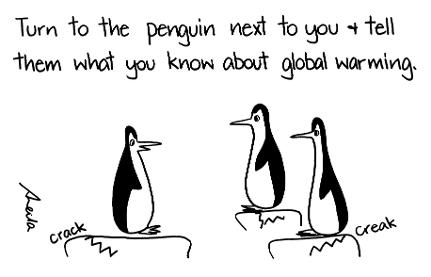 | 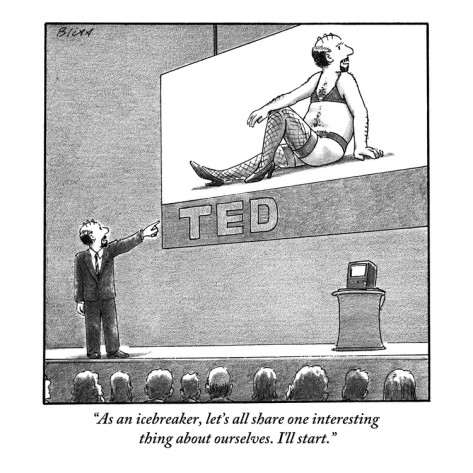 |
Advantages & Disadvantages
If an icebreaker is effective it can be a great tool in lowering defences, modelling appropriate behaviour, aiding communication and teamwork in groups, and enhancing learning (Chlup, 2010). However, if not facilitated properly icebreakers can be boring, or worst, damage group cohesion and be detrimental to learning (Kornik, 2006).
The Do's & Don'ts of icebreakers
Do:
- Match the right game with the right people.
- Use icebreakers to create a relaxed atmosphere.
- Be realistic about the right amount of people and resources needed to carry out the activity.
- Keep icebreaker instructions simple and to the point.
- Be ready to improvise if necessary.
- Have a contingency plan in case the icebreaker doesn't work.
Don't:
- Focus solely on having fun, people are there to learn something.
- Embarrass your participants by using inappropriate ice breakers or forcing them to participate.
- Forget to bring everything you need for the icebreaker.
- Limit yourself to using icebreakers at the beginning of a session.
- Underestimate the time needed to complete the icebreaker.
The skills needed?
Rogers (2010) states that the essential skills needed to facilitate an icebreaker are the same as those needed to facilitate any training session, meeting or event effectively:
- Be clear on your objective (what do you want to achieve?).
- Be prepared (match appropriate design with participants and subject/style of event, and undertake scenario planning)
- Be realistic (with allocating time and resources needed for the number of participates).
- Be able to evaluate (against your listed objectives whether the session was effective).
Following the 4 B's will aid in icebreaker sessions meeting their objectives efficiently and effectively!.
Additional resources
Useful website and video on icebreakers: http://www.mindtools.com/pages/article/newLDR_76.htm
Useful website on icebreakers: http://www.nwlink.com/~donclark/leader/icebreak.html
Examples of icebreakers: http://www.slideshare.net/jihadharb/six-great-ice-breakers
Other examples of interesting icebreakers and energizers: http://www.albany.edu/cpr/gf/resources/Icebreakers-and-Introductions.htm
Examples of 10 of the worst icebreakers: http://money.howstuffworks.com/business/professional-development/10-networking-tips-people-hate-networking.htm
Example of a contemporary icebreaker approach (appreciate inquiry icebreaker): http://www.tobyelwin.com/the-best-meeting-icebreaker-to-break-the-ice/
Journal article: Using appreciative intelligence for icebreaking - A new design: http://www.emeraldinsight.com/1366-5626.htm
Useful website defining appreciative intelligence: http://www.appreciativeintelligence.com/articles/Article%204.pdf
References
Break the ice: The phrase finder. [2012]. Available from http://www.phrases.org.uk/meanings/break-the-ice.html
Chlup, D., T & Collins, T., E. (2010). Breaking the Ice: Using Icebreakers and Re-energizers with Adult Learners. Adult Learning,21 (3/4), 34. Retrieved f from: http://search.proquest.com.ezproxy.ecu.edu.au/docview/1419030582
Dowty, S. (2006). ABC's of Icebreakers and Teambuilding Activities. Leadership for Student Activities, 34 (5), 35. Retrieved from:
http://search.proquest.com.ezproxy.ecu.edu.au/docview/234980186
Hogan, C. (2003). Practical Facilitation: A Toolkit of Techniques. London, England: Kogan Page Ltd.
Icebreaker: Definition of icebreaker in Oxford dictionary. [2013]. Available from http://oxforddictionaries.com/definition/american_english/icebreaker
Ice Breakers: Mind Tools. [1996]. Available from http://www.mindtools.com/pages/article/newLDR_76.htm
Kornik, J. (2006). More Icebreakers?.Training, 43 (2), 4. Retrieved from: http://search.proquest.com.ezproxy.ecu.edu.au/docview/203401772
Mclaughlin, M., & Peyser, S. (2004). The New Encyclopedia of Icebreakers. San Francisco, California: Pfeiffer.
Rogers, J. (2010). Facilitating Groups: Getting the best Out of a Group. Mainhead GBR. Open University Press.
Silberman, M. (2006). Training the Active Training Way: 8 Strategies to Spark Learning and Change. San Francisco, California: Pfeiffer.
Tuckman, B. W. (1965). Developmental sequence in small groups. Psychological Bulletin, 63 (6), 384-399. doi: 10.1037/h0022100
What is an Ice Breaker: About.com. [1999]. Available from http://humanresources.about.com/od/glossaryi/g/what-is-an-icebreaker.htm
